While an external audible siren is a powerful deterrent, it introduces a significant layer of legal and community responsibility for property owners of all descriptions. If an intruder alarm malfunctions and sounds continuously while a property is vacant, it quickly transitions from a security asset to a statutory noise nuisance.
Under UK environmental protection legislation, homes and businesses across the West Midlands can face substantial fines, system-silencing notices, and forced property entry if their security networks are poorly maintained. Managing your alarm’s acoustic footprint is, therefore, a matter of unquestionable legal compliance.
The Clean Neighbourhoods and Environment Act 2005
Under the Clean Neighbourhoods and Environment Act, local authorities such as Coventry City Council possess sweeping powers to control audible alarm nuisances. If an alarm rings continuously for more than 20 minutes, or intermittently for more than one hour, and is causing a disturbance to local residents, it is legally classified as a statutory nuisance.

If an environmental health officer verifies the nuisance, the council can take immediate legal action:
- Noise Abatement Notices: Issued directly to the property owner, demanding the immediate silencing of the system.
- Warrants to Enter Premises: If the owner cannot be contacted, the council can secure a warrant from a magistrate to legally break into the property, bypass the security casing, and manually disconnect the alarm system at the owner’s expense.
- Financial Penalties: Standard statutory fines for failing to comply with an abatement notice can reach up to £5,000 for residential homes and up to £20,000 for commercial premises.
The Keyholder Registration Mandate
To avoid emergency property break-ins by the local authority, areas designated as ‘Alarm Notification Areas’ require property owners to nominate official keyholders.
By law, you must provide the local Environmental Health department, in this case Coventry City Council’s Environmental Health and Regulatory Services, with the names, addresses, and telephone numbers of two designated keyholders who live within 20 minutes of the property and possess the codes and training required to silence the system. If you fail to register your keyholders and your alarm rings out unchecked, the council can issue an immediate fixed penalty notice.
Mitigating Nuisance Alarms Through Professional Installation & Maintenance
The overwhelming majority of statutory noise interventions are caused by unserviced hardware or poor system design. Professional engineering eliminates these failure points through distinct technical safeguards:
- Automatic Cut-Off Timers: Professional panels are programmed with hard-coded cutoff timers that automatically silence external sounders after a maximum of 15 minutes, conforming strictly to British Standard (BS) 4737 metrics.
- Dual-Element Intruder Detection: By utilising dual-technology sensors (combining passive infrared tracking with microwave distortion sensors), a professional system requires both environmental metrics to change simultaneously before triggering an alarm, eliminating false activations from blowing draughts or insects.
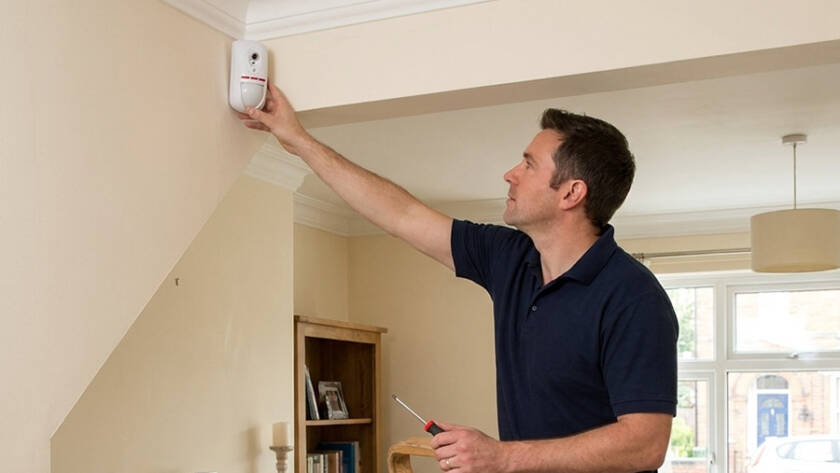
- Annual Diagnostic Verification: During regular preventative maintenance visits, engineers test the internal backup battery capacity. If a property experiences a mains power cut and the internal system backup battery is degraded, the external sounder will automatically trip out and ring continuously until the battery dies, a fault completely prevented by routine professional servicing.
Ensure your security system meets local environmental standards
Don’t let a faulty intruder alarm lead to council fines or a forced entry. Contact our NSI Gold-approved team to discover how we can design, install, and maintain your property’s burglar alarm systems.