Article Overview
Navigating commercial fire safety compliance across Coventry requires a clear understanding of legal obligations and local enforcement priorities. Under statutory guidelines, duty holders must maintain robust documentation that accurately reflects building layout, occupancy levels, structural compartmentation, and operational risks. This guide explores how commercial premises owners can systematically select third-party accredited assessors who possess the technical competence needed to satisfy strict statutory codes. By examining the legislative frameworks enforced across the West Midlands, duty holders can identify competent assessors, reduce non-compliance liabilities, and establish reliable safety protocols tailored to light-industrial, retail, and office environments. Ultimately, appointing a qualified specialist protects occupants, safeguards physical assets, and ensures commercial properties remain fully operational without facing sudden enforcement notices or costly business disruptions. It provides actionable insights into local risk factors, statutory duty-holder responsibilities, and practical criteria for selecting verified fire-safety professionals in the local area.
Commercial property managers and developers in built-up areas across Coventry frequently struggle to interpret complex statutory mandates surrounding fire safety compliance. Identifying a designated Responsible Person to oversee these technical requirements often creates significant confusion regarding legal liability, emergency planning, and operational exposure.
Failing to maintain a valid assessment under the Regulatory Reform Fire Safety Order 2005 can lead to severe operational penalties, including formal prohibition notices from the West Midlands Fire Service. Industry data shows that over 60% of commercial enforcement notices stem from inadequate risk assessments or incompetent assessors, resulting in average remedial costs exceeding £10000 and immediate operational shutdown.
Engaging a certified assessor registered with a recognised professional body ensures full statutory alignment through standardised digital auditing tools and advanced risk-modelling software. This proactive approach delivers clear, cost-effective remedial roadmaps that satisfy both Coventry City Council planning conditions and commercial insurance prerequisites without delaying core business operations.
KEY TAKEAWAYS
- ✓The designated Responsible Person holds direct legal accountability for carrying out a suitable and sufficient assessment under the Regulatory Reform Fire Safety Order 2005, requiring accurate documentation for all commercial premises.
- ✓Officers from the West Midlands Fire Service and Coventry City Council actively enforce statutory compliance, conducting rigorous audits that can result in immediate prohibition notices, formal prosecution, or heavy fines for non-compliant sites.
- ✓Appointing a third-party accredited assessor guarantees technical competence, delivering a clean, cost-effective remedial strategy that satisfies local authority requirements and protects business continuity.

Need Specialist Advice on Coventry fire risk assessment?
Speak to our technical team today for tailored specifications, regulations compliance, and practical support.
Speak to a SpecialistEssential qualifications and professional accreditations to look for
Third-Party Certification Frameworks
Third-Party Certification provides independent verification that an assessor possesses the required technical competence to evaluate commercial properties. Choosing an accredited assessor guarantees their assessment processes meet strict national standards and protects site owners from statutory non-compliance.
Commercial property owners in Coventry must ensure their chosen risk assessor operates under robust auditing frameworks. Independent auditing bodies evaluate both the individual assessor and the quality management systems of the company employing them. Schemes like the BAFE SP205 scheme set the clear industry benchmark for commercial fire-risk assessment companies. Licensing bodies such as the National Security Inspectorate perform regular audits on accredited firms to confirm ongoing compliance with UK fire-safety legislation. Selecting an accredited firm ensures your report withstands strict scrutiny from West Midlands Fire Service enforcement officers during routine inspections. Accredited providers also maintain valid professional indemnity insurance, typically providing £2,000,000 to £5,000,000 in cover to protect your business against liability claims.
Professional Body Register Membership
Registration with recognised industry bodies confirms that an individual maintains active professional competence through continuous training. The Institute of Fire Engineers keeps comprehensive registers of qualified assessors who demonstrate proven technical expertise in complex commercial environments.
Individual qualifications matter just as much as company accreditation when evaluating fire-safety specialists. The Institute of Fire Engineers categorises assessors across distinct competency tiers based on practical experience, formal examination, and peer reviews. Higher tier registrations demonstrate that an assessor can handle complex multi-storey offices, light-industrial units, and historic city-centre structures across Coventry. Registered professionals must complete 30 hours of mandatory continuous professional development every 1 year to maintain active status. This ongoing education guarantees that your assessor understands recent updates to UK building regulations, structural fire-protection measures, and emergency evacuation protocols.
Local Experience in Coventry Commercial Sectors
Assessors with direct experience across Coventry commercial sectors understand specific building archetypes and local industrial risks. Evaluating an assessor's track record in similar local premises ensures your assessment addresses relevant operational fire hazards.
Coventry features a diverse commercial landscape ranging from modern technology parks to multi-tenanted 1960s office blocks and industrial units near local streets and industrial estates. Assessors familiar with these property types quickly identify common structural defects, shared escape route issues, and compartmentation failures. Checking that your assessor has completed at least 50 commercial risk assessments within Coventry or surrounding West Midlands areas guarantees practical, location-specific guidance.
| Specification | Primary Features | Lifespan | Cost Bracket | Compliance |
|---|---|---|---|---|
| Basic Assessor Standard | Visual checklist audit, simple spatial layout review, basic escape route verification for low-risk single-storey commercial units | 1 year | £250 - £450 | Regulatory Reform Fire Safety Order 2005 baseline |
| IFE Tier 2 Registered Assessor | Detailed hazard identification, evacuation strategy planning, compartmentation review for standard Coventry commercial premises | 1 year | £450 - £850 | PAS 79-1 2020 and Article 17 Fire Safety Order |
| BAFE SP205 Accredited Company | Third-party quality assured audit, fire door integrity sampling, active protection systems integration testing | 1 year | £850 - £1,600 | BAFE SP205, PAS 79-1 2020, Fire Safety Act 2021 |
| Tier 3 Fire Risk Specialist | Complex multi-occupancy analysis, dynamic smoke control review, Golden Thread safety case integration for high-risk buildings | 1 year | £1,600 - £3,500 | Building Safety Act 2022 and Approved Document B |
Key elements a thorough Coventry fire risk assessment must cover
Structural Integrity and Fire Compartmentation Audit
A thorough assessment must rigorously evaluate Fire Compartmentation to ensure passive fire protection stops smoke and flames from spreading between building zones. This includes inspecting fire doors, walls, floors, and pipe penetrations across the commercial premises.
In older manufacturing plants or modern office blocks in the city, breaches in compartment boundaries represent a primary safety risk. Assessors conduct detailed visual checks to confirm fire-stopping materials remain fully intact around modern utility cabling and heating pipework. A reliable inspector follows a clear 3-step audit routine.
1. Inspect all fire-rated doors to ensure intumescent seals, drop-down threshold mechanisms, and self-closing devices operate properly. 2. Examine void spaces above suspended ceilings and beneath raised access floors for unsealed breaches. 3. Verify that structural fire protection coatings on steelwork remain undamaged and fully effective.
Means of Escape and Evacuation Route Audits
The assessment must guarantee that every Means of Escape is fully clear, correctly illuminated, and simple for occupants to navigate under zero-visibility conditions. Assessors review travel distances from the furthest work point to the nearest safe exit to comply with UK safety standards.
Properly installed Emergency Lighting systems are thoroughly audited to ensure pathways stay visible if main electrical power feeds fail. Assessors also inspect Access Control Systems on turnstiles and security doors, verifying that power-loss override mechanisms instantly release electromagnetic locks when the fire alarm activates. High-density workplaces on busy local streets need exit routes designed for fast mass evacuations without creating dangerous bottlenecks or physical obstructions.
Detection and Warning Infrastructure Reviews
Every valid audit examines installed Commercial Fire Detection Systems to confirm that heat and smoke sensors cover all high-risk areas across the building layout. The assessor cross-references sensor placement against potential ignition sources like staff kitchens, server rooms, and plant machinery.
They review maintenance logs to confirm 100% compliance with weekly call-point testing schedules and bi-annual servicing protocols. Control panels must display clear zone mapping so emergency services can identify incident locations within 30 seconds of arrival. Assessors also check that audible sounders achieve at least 65 decibels across all working spaces, ensuring staff are alerted instantly.
Emergency Management and Staff Training Records
Assessors must review operational emergency procedures to ensure staff members understand exact evacuation protocols during a building alarm. This process involves verifying fire drill frequency, designated marshal training, and personal emergency evacuation plans for vulnerable occupants.
In multi-tenanted commercial properties across the city centre, coordinated response protocols are essential for life safety. Assessors evaluate how emergency information is communicated between different business entities operating under 1 shared roof. They confirm that written fire action notices are displayed beside every manual call point and that portable firefighting equipment receives annual servicing by certified engineers.
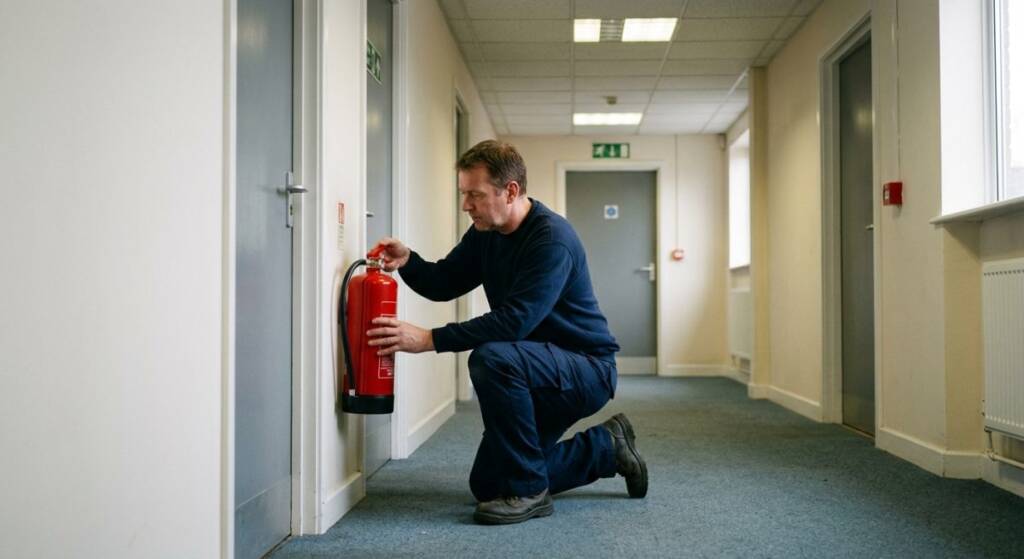
Evaluating local experience across industrial and heritage properties in Warwickshire
Assessing Heritage Constraints in Historic City Properties
Assessing historic timber-framed structures requires a deep understanding of legacy building materials and non-standard compartmentation limits. Qualified assessors must balance strict conservation guidelines against modern life-safety obligations under the Regulatory Reform (Fire Safety) Order 2005. When evaluating Coventry City Centre Heritage Buildings, standard off-the-shelf fire risk templates fail completely. Assessors need direct experience with lathe-and-plaster walls, hidden voids, and timber frames where modern fire-stopping techniques might damage protected fabric.
A specialist assessor evaluates these historic sites through a structured 3-step physical inspection sequence:
1. Inspect hidden void spaces, roof trusses, and service risers for unsealed penetrations. 2. Audit structural compartmentation integrity without damaging historic lath or timber panels. 3. Verify that sensitive fire-detection hardware integrates seamlessly with low-impact wiring routes.
Evaluating High-Risk Hazards across Regional Industrial Sites
Industrial facilities present complex risk profiles due to heavy plant machinery, bulk chemical storage, and large open-plan layouts. An experienced assessor identifies specific ignition sources and evaluates emergency suppression systems across modern manufacturing units. Within various Warwickshire Industrial Estates, properties range from 1960s steel-portal frames to state-of-the-art logistics hubs spanning 10000 square metres. Assessors must recognise high-density racking risks, dust explosion hazards, and hot-work permit controls. Choosing a professional who understands 30-minute structural fire ratings, high-bay sprinkler requirements, and hazardous substance storage ensures your risk management plan remains fully compliant. They will also audit charging stations for electric forklift trucks, which represent a rising fire threat in modern warehouses.
Managing Complex Risk Profiles in Multi-Occupancy Sites
Multi-tenant premises present distinct challenges where shared escape routes and varied operational hours overlap. Competent assessors evaluate responsibility boundaries between individual tenants and overarching building management teams. In dynamic Mixed Use Commercial Premises, retail units on ground floors often share stairwells, alarm panels, and service ducts with upper-floor office spaces or flats. A qualified assessor maps out the overall physical layout to ensure that a fire starting in a high-risk commercial kitchen does not compromise the primary escape route for 50 office workers above. They review joint fire-evacuation plans, verify shared alarm testing regimes, and ensure that clear clear-way policies operate across all common corridors. Assessing emergency lighting coverage across 2 or 3 separate tenant zones requires an intimate knowledge of localised British Standards and real-world evacuation behaviours.
Post assessment support and integrating fire protection systems
Ongoing Technical Support and Action Plans
Qualified fire risk assessors deliver continuous guidance to help Coventry business owners implement required safety upgrades efficiently. This ongoing partnership ensures that the remedial works outlined in your initial evaluation are properly executed and documented.
A thorough assessment yields a structured Fire Safety Action Plan that prioritises risks based on severity, legal necessity, and practical feasibility. Your technical assessor should remain accessible to review contractor quotes, verify completed physical works, and adjust recommendations as operational needs change across your premises. They also refine your Emergency Evacuation Plan to reflect structural alterations, updated staffing levels, or shift patterns, ensuring 100% compliance with current UK fire safety legislation across your Coventry site. Choosing an assessor who offers long-term advice prevents costly compliance gaps, streamlines annual audits, and protects your capital investment over 5 to 10 years.
Integrating Active and Passive Protection Systems
Modern commercial premises require seamless communication between fire detection infrastructure and physical containment measures. A competent assessor evaluates how these systems interact to prevent smoke spread and assist prompt building clearance.
Integrating fire doors, automated dampers, and built-in extraction fans with your primary alarm panel creates a reliable, multi-layered defence. Qualified assessors verify these complex mechanical and electrical linkages during post-assessment reviews through a standardised 3-step testing procedure.
1. Test signal transmission from smoke detectors to automated door closers and smoke extraction dampers. 2. Verify manual call point activation triggers immediate fire-suppression system responses across all 4 operational zones within 2 seconds. 3. Confirm emergency lighting units activate within 3 seconds of main power disconnection to guide occupants safely along escape routes.
Routine Testing and System Monitoring
Scheduled testing routines maintain compliance and ensure rapid emergency responses across complex commercial sites. Linking alarm alerts with external monitoring services minimises response times during off-peak operational hours.
Comprehensive post-assessment support must cover regular Fire Alarm Maintenance alongside specialised third-party system connections. Modern commercial facilities frequently link automated fire panels with off-site CCTV Monitoring hubs, enabling trained operators to visually confirm smoke or heat signatures before dispatching blue-light services. This integration reduces false alarms by up to 85% and provides continuous 24-hour protection for vacant industrial units, multi-storey office complexes, and retail spaces across local streets in Coventry. Your assessor helps establish cost-effective 1-year to 5-year maintenance schedules that satisfy both West Midlands Fire Service inspectors and commercial insurance underwriters.

Frequently Asked Questions around Coventry Fire Risk Assessment
Is a Commercial Fire Risk Assessment Legally Required in Coventry?
Yes, a commercial fire risk assessment is a strict legal requirement for all business premises in Coventry under the Regulatory Reform (Fire Safety) Order 2005.
If your organisation employs 5 or more people, you must keep a written record of the assessment. This statutory rule applies to offices, retail shops, warehouses, factories, and commercial venues across the city.
Who is Responsible for Arranging a Fire Risk Assessment for a Business Premises?
The designated responsible person, typically the business owner, employer, building manager, or landlord, holds legal responsibility for arranging the assessment.
In multi-tenanted commercial buildings across Coventry, joint cooperation between building owners and individual tenants is mandatory to ensure 100% safety compliance across all shared escape routes and communal areas.
How Often Should You Review Your Coventry Fire Risk Assessment?
You must review your fire risk assessment at least once every 12 months or immediately whenever significant changes occur in your building.
Changes that trigger an immediate review include structural alterations, changes to layout, new machinery, higher staff numbers, or revised working hours. A full re-assessment by a competent specialist is recommended every 3 to 5 years.
What Qualifications Should a Qualified Fire Risk Assessor Hold?
A qualified assessor should possess recognised professional credentials from registered fire-safety bodies such as the Institute of Fire Safety Managers or the Institution of Fire Engineers.
Choosing an assessor with third-party accreditation guarantees that they have proven technical expertise to evaluate complex commercial sites accurately and safely.
Why Should You Choose a Third-Party Accredited Assessor in Coventry?
Selecting a third-party accredited assessor guarantees that your fire risk report meets strict national standards and satisfies West Midlands Fire Service requirements.
Accredited specialists undergo independent quality audits to prove their ongoing technical competence. This protects your commercial enterprise from costly legal penalties while providing high-quality risk management advice.
What Does a Professional Commercial Fire Risk Assessment Involve?
A professional assessment involves an extensive physical inspection of your site to identify potential fire hazards, evaluate evacuation routes, and test safety management systems.
The specialist consultant will inspect your fire-detection equipment, emergency lighting, fire doors, and staff training records. You will then receive a prioritised action plan detailing specific measures to minimize fire hazards.
How Long Does a Fire Risk Assessment Take to Complete?
A physical site inspection typically takes between 2 to 5 hours depending on the overall floor area and operational complexity of your premises.
Following the physical survey, your completed written report is usually compiled and delivered within 3 to 5 working days. Larger industrial facilities or complex multi-storey commercial buildings may require up to 2 days on-site.
What Happens if You Fail to Have a Valid Fire Risk Assessment?
Failure to maintain a valid fire risk assessment can result in severe financial penalties, formal prohibition notices, or the complete closure of your site.
Local enforcement officers can issue formal notices with strict 28-day compliance deadlines. In severe cases, unlimited fines or custodial sentences of up to 2 years can be imposed on non-compliant business owners.
Does a New Business in Coventry Need a Fire Risk Assessment Before Opening?
Yes, every new business must have a valid fire risk assessment completed before opening its doors to staff or members of the public.
Arranging an assessment during the initial fit-out phase allows you to install required fire-prevention systems cost-effectively before normal trading begins.
How Much Does a Commercial Fire Risk Assessment Cost in Coventry?
The cost of a commercial fire risk assessment in Coventry typically starts from £200 for small premises and ranges up to £1000 or more for large industrial facilities.
Final pricing depends on total square footage, building layout complexity, hazard levels, and the number of staff present. Investing in a competent assessor provides long-term legal protection and ensures high-quality safety standards for your business.
Ready to Discuss Your Coventry fire risk assessment Project?
Get in touch with our specialists today for detailed site guidance, technical specifications, and a quotation tailored to your requirements.
Contact Our Team